Agricultural Institute of Slovenia
How to conserve native honey bees
A presentation video for the international BeeConSel project on genetic erosion and mating control in honey bees
- Client
- Agricultural Institute of Slovenia
- Year
- 2023–2024

When beekeepers buy queens of foreign breeds for their economic traits instead of rearing locally adapted bees, native subspecies slowly mix and disappear. This is called genetic erosion. For the Carniolan, Macedonian and dark honey bee it is not just a technical term but a real risk.
For the Agricultural Institute of Slovenia we made a presentation video for the international BeeConSel project (Joint Effort for Honey Bee Conservation and Selection). The video explains the problem clearly and shows four mating control methods that breeders and beekeepers can use to solve it.
The video in numbers
- 5
- Countries in the consortium: Slovenia, Croatia, North Macedonia, Norway and Sweden.
- 4
- Mating control methods, explained and visualised with animated infographics.
- 5
- Researchers from five countries who explain the problem and the solutions.
- 4
- Languages: the English original plus subtitles and graphics in Slovenian, Croatian and Macedonian.
01A problem you can't see
Bees are key to the ecosystem and to food production, as they also pollinate large monocultures. A queen mates in the air with drones from the wider area, so a beekeeper cannot simply choose her mates. When foreign breeds spread nearby, the native bee mixes generation after generation and loses the traits that adapted it to the local climate and diseases.
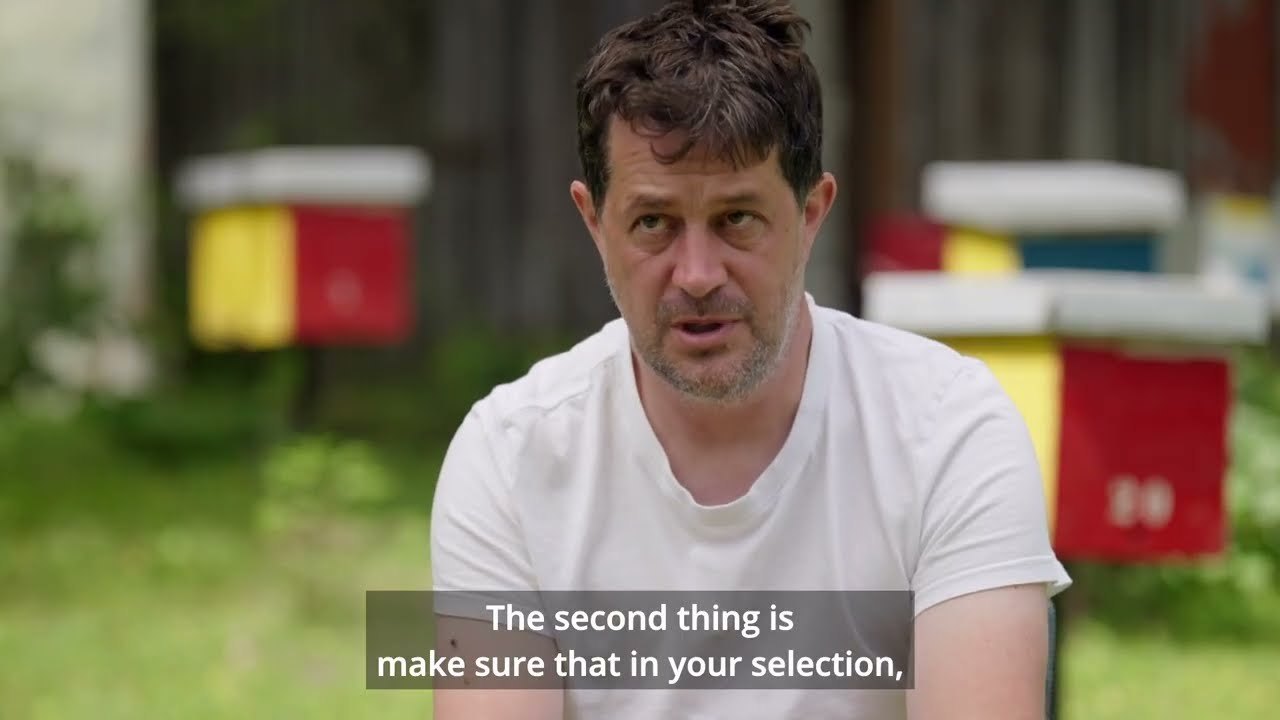
In the opening of the video the problem is presented by project coordinator Janez Prešern of the Agricultural Institute of Slovenia, over footage of pastures, apiaries, bees on flowers and drones in flight.
The video's message
Breeding native bees depends on one factor: controlled mating.
02Four methods of mating control
The core of the video is the solutions. The project offers breeders and beekeepers four methods, each tested where conditions suit it best. We explained them with fieldwork (mating stations, queen marking, hive inspections) and with animated infographics that show the difference before and after mating control.
A mating station where foreign drones can't reach.
Queens mate at a remote location where only drones from selected colonies are within flying range. Slovenia uses two Alpine valleys, including Krma.
Mating outside the natural flight hours.
Queens and selected drones are released at a time of day when other drones don't fly. North Macedonia is testing this method.
So many selected drones that foreign ones are a minority.
The area around the mating station is saturated with colonies that produce selected drones, a technique known as drone swamping. Foreign drones are then a minority and unwanted mating is unlikely.
Full control when isolation isn't possible.
Where there are no suitable remote locations, experts inseminate the queens. This is how it is done in Croatia.
What mating control brings
- Queens mate with drones of foreign breeds
- Native subspecies mix and disappear
- Bees less adapted to local conditions
- Slow and uncertain selection
- Mating with selected drones
- Genetic diversity of native bees preserved
- Better survival and vitality of local bees
- Faster and more precise selection
03It takes cooperation
The video closes by highlighting the expert support of the Swedish university and the fact that native breeds cannot be preserved without close cooperation between beekeepers, breeders and local authorities. The video features Janez Prešern (Slovenia), Bjørn Dahle (Norway), Marin Kovačić (Croatia), Aleksandar Uzunov (North Macedonia) and Sreten Andonov (Sweden).
Structure of the video
-
Opening
The problem
Why bees matter for nature and food, why beekeepers buy foreign breeds and what genetic erosion means. Footage of nature, apiaries and drones in flight, including aerial shots.
-
Core
Four solutions
Geographic, temporal and biological isolation and artificial insemination, with fieldwork and animated infographics.
-
Closing
Cooperation
Expert support, the role of beekeepers, breeders and authorities, and a call to conserve native breeds together.
04One video, four languages
What we did
-
01
Field filming
Pastures, apiaries, mating stations, queen marking and hive inspections, also from the air.
-
02
Interviews with researchers
Five experts from five countries, filmed in English so the video works internationally.
-
03
Animated infographics
The four methods and the effect of selection before and after mating control, shown so that any beekeeper can follow.
-
04
Translations and subtitles
We translated and adapted the graphics and subtitles into Slovenian, Croatian and Macedonian.
The BeeConSel project
- 17,000+
- Samples collected and processed.
- 16
- Locations in four countries where the approaches were tested.
- 3
- Years, from December 2020 to the end of 2023.
- 3
- Countries where controlled mating proved feasible: Slovenia, Croatia and North Macedonia.
The project showed that controlled mating is feasible in all three countries and takes less effort than expected. At the end of the project, the video became its main presentation for beekeepers, breeders and decision-makers. The project was funded by Iceland, Liechtenstein and Norway through the EEA and Norway Grants Fund for Regional Cooperation. More about the project at beeconsel.eu.
05Where this project sits in our matrix
We work across all of these layers, and any combination is possible.
- Who we worked for
- Executive leadershipCorporate communicationsHRMarketingPublic sector
- Project scope
- Small brand storyAlways-on communicationBig brand story (a full campaign)
- What we improved
- ProcessesRelationshipsContent
- How we approached it
- StrategicallyDigitally, with AICreativelyIn an advisory role
- How long?
- Short-term (up to 3 months)Mid-term (3–12 months)Long-term (a year or more)
- What we created
- DocumentsPresentationsVisual identitiesDesignWebsitesSocial mediaCopywritingPhotographyVideo storiesAnimationsPodcastsEventsWorkshops